
What AS1940 Means for Storing Diesel on Your Site
If you store diesel on a farm, a mine site, a civil project or a transport depot, AS1940 is the document that decides whether your setup is defensible or a liability. Most operators have heard the number. Far fewer have read what it actually asks of them.
This guide explains AS 1940:2017: what it covers, what it does not cover, where separation distances come from, how bunding and safe fill levels work and where your state regulator adds rules on top. There is a printable site audit checklist at the end so you can walk your yard and mark off what passes.
What AS1940 actually is
AS 1940:2017 is the Australian Standard titled The storage and handling of flammable and combustible liquids, published by Standards Australia. It sets out design, installation, separation, containment, ventilation and operational requirements for storing liquids like diesel, petrol, kerosene, heating oil and a long list of solvents.
It is written as a technical standard, not as legislation. That distinction matters, and it is the single most misunderstood point about the whole document.
Is AS1940 a law?
No – it’s a standard, not legislation. But it can carry legal weight if it’s referenced in a Work Health and Safety Regulation, EPA licence, Dangerous Goods regulation, or council consent. In practice, almost every Australian jurisdiction does exactly that for bulk fuel storage, so compliance with AS1940 is treated as the baseline expectation by regulators, insurers and auditors.
The practical effect is simple. If something goes wrong on your site, the first question asked will be whether your installation met the standard.
Is diesel flammable or combustible?
Diesel is a combustible liquid, not a flammable one, and this classification drives almost every requirement that follows.
Under the GHS classification system used in Australian WHS Regulations, a liquid is treated as flammable when its flash point sits below 60 degrees Celsius. AS1940 uses a threshold of 61.5 degrees Celsius to separate flammable liquids from combustible ones. Diesel typically has a flash point above that mark, which places it in the combustible category.
The classes that matter on a fuel site are:
| Class | Description | Typical products |
| Class 3 | Flammable liquid, flash point below 61.5 degrees C | Petrol, avgas, many solvents |
| Class C1 | Combustible liquid, flash point at or above 61.5 degrees C and below 93 degrees C | Diesel, heating oil, kerosene grades |
| Class C2 | Combustible liquid, flash point at or above 93 degrees C | Many lubricating and hydraulic oils |
Diesel sitting in Class C1 means it attracts lighter separation and hazardous area requirements than petrol, but it is still captured by the standard. Operators who assume diesel is exempt because it will not flash at ambient temperature are the ones who get caught out at audit. Diesel will burn readily once heated, misted or absorbed into a wick material such as lagging or soil.
It also means the trigger points for things like high level alarms and placarding differ between diesel and petrol on the same site. Storing both changes the picture again, because the aggregate quantities are what count.
What size diesel tank triggers AS1940?
There’s no minimum size — AS1940 applies to bulk diesel storage of any capacity. However, the compliance requirements scale up sharply as the volume increases. Smaller quantities kept in approved containers (rather than bulk storage) are covered by separate, lighter provisions for packaged storage.. Once you move into a fixed bulk tank, the full design, separation and containment requirements apply.
The thresholds that change your obligations in practice are:
- Package and minor storage: small volumes in drums or approved containers, subject to basic segregation and spill control.
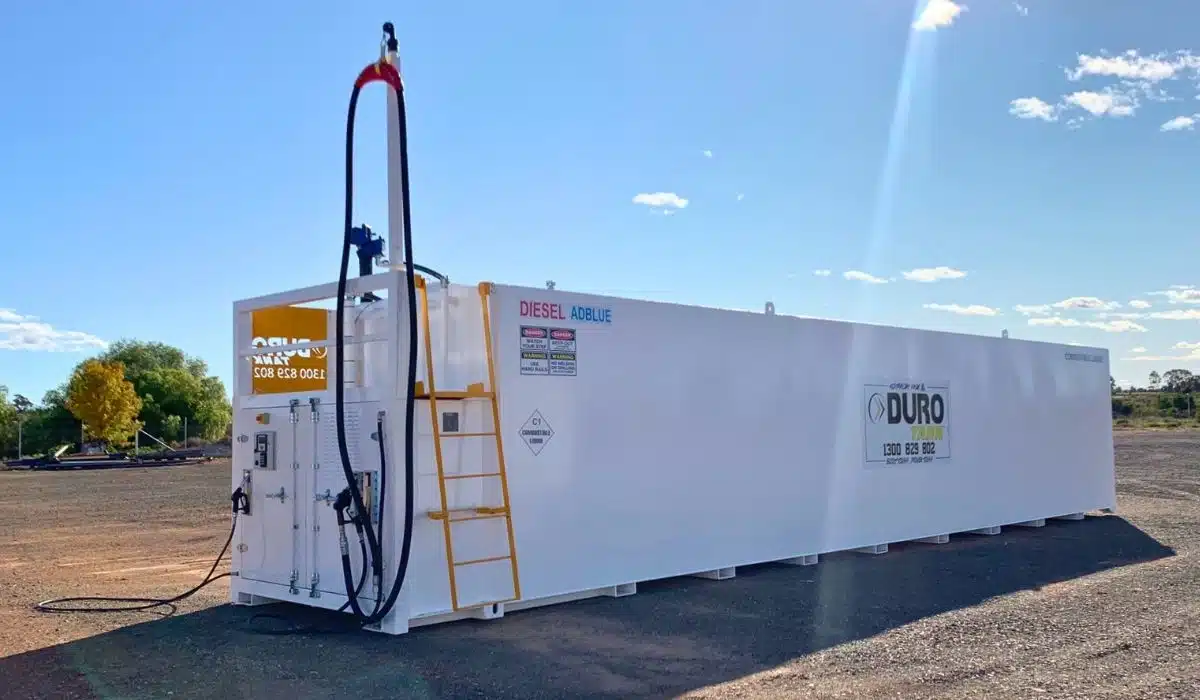
- Bulk storage: any fixed tank installation, which brings separation distances, secondary containment, venting, fill point protection and signage into scope.
- Placard quantity: the point at which hazardous goods placards must be displayed at site entry and at the storage area.
- Manifest quantity: a higher threshold at which you must keep a written manifest, provide a site plan for emergency services and, in most jurisdictions, notify the WHS regulator.
Placard and manifest quantities are set in the WHS Regulations for your state or territory, not in AS1940 itself. They differ between flammable Class 3 goods and combustible C1 liquids, and the diesel thresholds are considerably higher than the petrol ones. Check the schedule that applies where you operate before assuming a 10,000 litre diesel tank does or does not require notification.
A useful rule of thumb: if your total on-site diesel volume is heading past 10,000 litres, treat the installation as a regulated bulk facility and design it accordingly from day one. Retrofitting containment and separation after the concrete is poured is the most expensive way to reach compliance.
Separation distances: where the numbers come from
Separation distance is the minimum clearance required between your tank and everything around it. It is the requirement most often ignored on rural and remote sites, and the one most likely to be picked up during an insurance inspection.
AS1940 sets separation distances in tabular form, with the required clearance driven by three variables:
- Liquid class. Class 3 flammable liquids demand far greater clearance than Class C1 diesel.
- Tank capacity. Distances step up as stored volume increases.
- What you are separating from. The standard distinguishes between site boundaries, protected places, buildings on the same site, ignition sources, other tanks and public roads.
A “protected place” is broadly anything where people gather or where a fire would spread beyond your control: dwellings, offices, workshops with occupants, schools, hospitals, assembly buildings and adjoining property that could reasonably be built on.
The variables you need before you can read the table
Before you can determine your required clearance, you need to know:
- The class of every liquid stored, including any petrol, solvent or oil sharing the compound
- The capacity of each individual tank and the aggregate capacity of the group
- Whether the tank is self bunded, compound bunded, underground or above ground
- Whether any fire protection measures are installed, since some measures permit reduced distances
- The location of every ignition source within the potential zone, including switchboards, generators, welding bays, vehicle parking and refuse areas
Important: the specific clearance figures sit in the separation distance tables inside AS 1940:2017. We have not reproduced the table values here because Standards Australia holds copyright over the document and because using a figure out of context is how installations fail. Purchase the standard, or ask our team to walk your site plan against it before you commit to a location.
Where separation goes wrong in the real world
Three patterns account for most of the problems we see:
The tank was placed against the fence. A boundary looks like empty space, so it becomes the default location. It is the one clearance the standard is strictest about, because a neighbour can build on their side at any time.
The relocated tank. A skid-mounted tank gets shifted to suit a new stockpile or a new shed. Nobody re-measures.
Aggregated capacity. Two 10,000 litre tanks side by side are not treated as two small installations. Grouped tanks are assessed on their combined capacity plus the clearance between the tanks themselves.
If you cannot achieve the required clearance on your site, the usual paths forward are a fire rated tank with a UL2085 or equivalent construction, a rated fire wall between the tank and the protected place, or relocation. A self bunded tank built to a fire-rated specification is frequently the cheapest way to make a constrained site work, because it solves containment and clearance in one purchase.
Secondary containment and the 110% rule
Every bulk diesel installation needs secondary containment capable of holding a full tank failure. AS1940 sets the required capacity at 110% of the largest tank inside the containment, or a proportion of the aggregate capacity where multiple tanks share a bund, whichever is greater.
The extra volume margin accounts for operational factors like liquid displacement, direct rainfall in open-air compounds, and emergency response fluids.
Compound bunds
A compound bund is a concrete or earthen wall built around a single wall tank. It works, and it remains legal where correctly designed and maintained. It also brings ongoing costs that buyers rarely price in:
- Rainwater collects in the bund and becomes contaminated stormwater the moment any hydrocarbon sheen is present
- That water must be tested and disposed of through a licensed contractor, not pumped onto the ground
- Bund walls crack, joints degrade and penetrations leak, so the structure needs inspection and periodic recertification
- The tank cannot be relocated without abandoning the civil works
Does a self bunded tank satisfy bunding requirements?
Yes. A self bunded tank has an integral outer shell that provides the required secondary containment, so no separate bund is needed. The interstitial space between the inner and outer walls is designed to hold the full contents of the inner tank plus the required margin, and it can be monitored so a leak is detected before anything reaches the ground.
That is the core reason self bunded units dominate new installations in Australia. They arrive as a complete compliant package, they can be craned onto a new pad when the site changes and they remove the contaminated water problem entirely because rain never enters the containment. Our article on how self bunded tanks support Australian fuel storage compliance covers the mechanics in detail.
Whichever route you take, containment is only compliant if it is intact. Blocked bund drains, valves left open and cracked concrete are all findings we see written up on otherwise well run sites.
Safe fill level and high level alarms
Overfilling is the most common cause of diesel spills at the fill point, and AS1940 addresses it with two linked controls.
What is the safe fill level under AS1940?
The safe fill level is the maximum volume a tank may be filled to during normal operation, set at 95% of the tank’s total capacity. The remaining 5% is ullage, which allows the fuel to expand as temperature rises without forcing product out through the vent. Filling to the brim on a cool morning is how diesel ends up on the hardstand by early afternoon.
High level alarm thresholds
An audible and visual high level alarm is required so the operator delivering fuel gets a warning before the safe fill level is reached. The capacity at which this becomes mandatory depends on the liquid class:
- Flammable liquids (Class 3): tanks of 5,000 litres and above
- Combustible liquids (Class C1 and C2, including diesel): tanks of 25,000 litres and above
Below those thresholds, an alarm is not mandated, but it is cheap insurance and most operators fit one anyway. Larger installations such as our 50,000 litre self bunded smart tank come with an alarm as standard for exactly this reason.
Alongside the alarm, the fill point itself needs attention: a spill containment box under the connection, a clearly marked and secured fill line and a documented delivery procedure so the driver is not left guessing at the current level.
Venting, hazardous areas and fire protection
Three further requirements catch out operators who focus only on containment.
Venting. Every tank needs normal venting to handle filling and thermal breathing. Vent outlets must discharge to a safe location, clear of ignition sources and building openings.
Hazardous area zoning. Around fill points and vent outlets, AS1940 defines zones where an explosive atmosphere may be present. Diesel generates far smaller zones than petrol because of its higher flash point, but the zones are not zero. Any electrical equipment inside a zone must be rated for the classification, which affects pump wiring, lighting and level sensors.
Fire protection. Requirements scale with capacity and site risk. For most diesel installations this means portable extinguishers of the correct type and rating, positioned at accessible points near the storage area, with maintained tags. Larger facilities may need fixed systems and a documented emergency plan.
Transport, delivery and the ADG Code
AS1940 governs storage. The moment fuel moves on a public road, the Australian Dangerous Goods Code takes over, covering vehicle placarding, driver licensing, documentation and packaging.
The two intersect at your delivery point. If a tanker cannot safely access your fill point, turn around without reversing blind, and remain clear of your protected places while decanting, your storage design has created a transport problem. Plan the access route and the standing area at the same time you plan the pad.
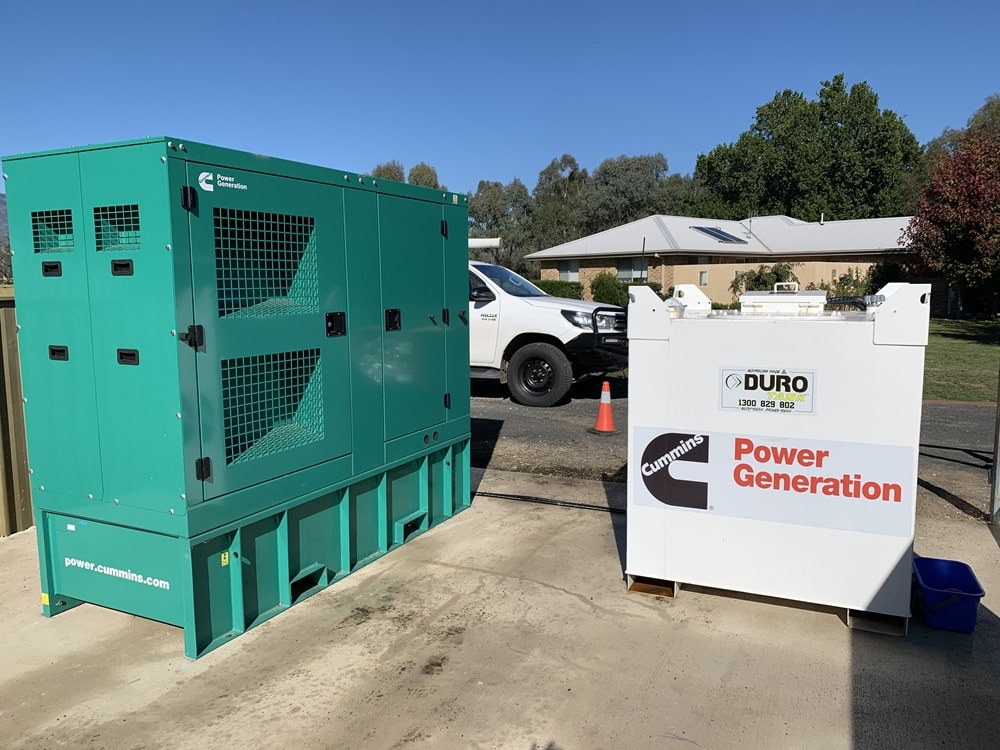
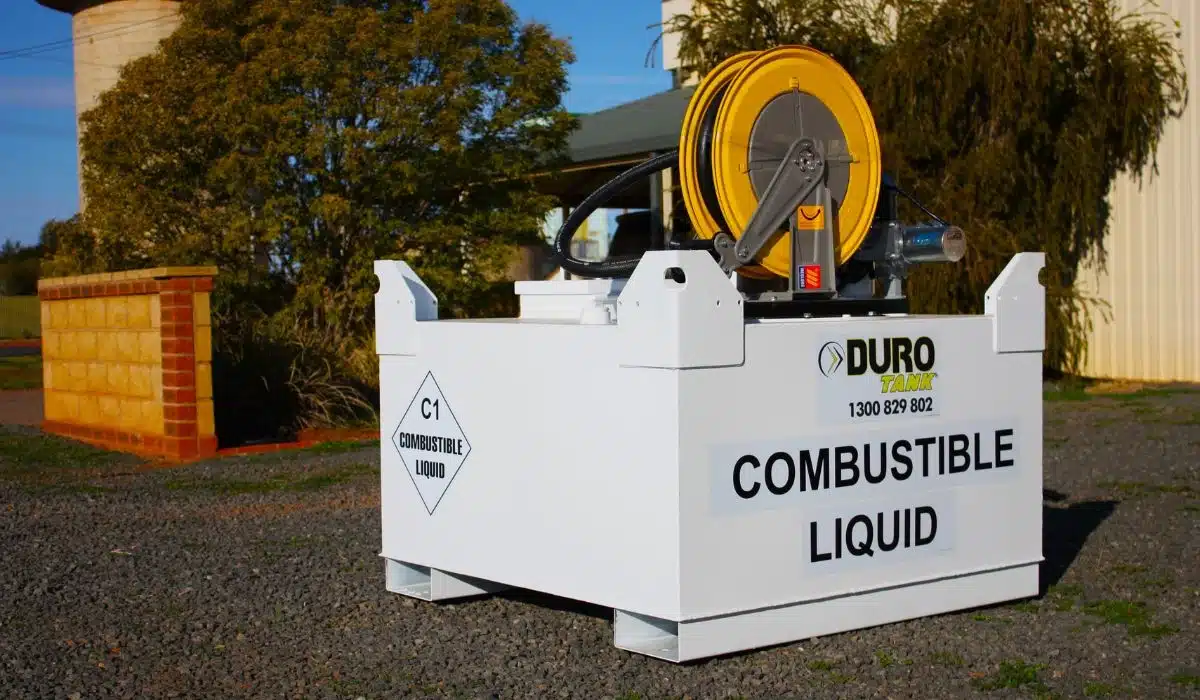
Sites that move a demountable tank between locations also need to consider how the unit travels. Compact skid units such as the 4,500 litre self bunded duro cube are built to be lifted and transported, which keeps a mobile operation compliant at every location rather than only at the yard.
State by state: where the rules change
This is the layer most guides skip. AS1940 is national, but the legislation that enforces it, the environmental conditions attached to it and the approvals required before you install are all set at state and local level. The pattern varies as follows.
New South Wales. WHS Regulation 2017 governs hazardous chemicals and dangerous goods, with SafeWork NSW as the regulator. The NSW EPA administers environmental protection licensing for larger facilities and takes a firm line on contaminated stormwater from bunded areas. Local councils control development consent for new fuel storage structures.
Victoria. WorkSafe Victoria administers the Dangerous Goods Act and Regulations, and a licence is required to store above prescribed quantities. EPA Victoria’s general environmental duty places an active obligation on operators to minimise risk of harm, which raises the bar above simply meeting the standard.
Queensland. Workplace Health and Safety Queensland regulates hazardous chemicals, while the Department of Environment administers environmentally relevant activities. Larger fuel storage and any associated refuelling activity can trigger an ERA registration.
Western Australia. The Dangerous Goods Safety Act and Regulations are administered by the Department of Energy, Mines, Industry Regulation and Safety, with a specific licensing regime for dangerous goods sites. Mining operations carry additional obligations under mine safety legislation.
South Australia, Tasmania, ACT and Northern Territory. Each applies its own dangerous goods and WHS framework, with SafeWork SA, WorkSafe Tasmania, WorkSafe ACT and NT WorkSafe as the respective regulators, plus separate EPA arrangements.
Do I need council approval?
Often, yes. A fixed bulk fuel installation is usually treated as a structure requiring development approval, particularly where it involves a concrete pad, a bund, a permanent canopy or a change of land use. Rural properties sometimes have exemptions for agricultural fuel storage below a set volume, and some councils treat a relocatable self bunded tank differently from a fixed installation with civil works.
The only reliable approach is to call your council’s duty planner before you order, describe the tank type, capacity and proposed location and get the answer in writing. Approval after installation is always more expensive than approval before it.
For a broader treatment of how these frameworks fit together across the country, see our ultimate guide to diesel fuel tank compliance in Australia.
When you are comparing steel fuel tanks, they can look remarkably similar on paper. They may have the same capacity,…
Search this question online and you will drown in British heating oil advice. OFTEC guidance, Environment Agency rules, Scottish EPA…
Buying a diesel tank looks simple until you start comparing them. Capacities range from a few hundred litres to six…
AdBlue has become a non-negotiable part of running a modern diesel fleet. Almost every truck, tractor, generator and piece of…
Diesel prices in Australia have hit record levels in 2026. Geopolitical disruption has pushed per-litre costs to their highest point…

When stored diesel is left unmanaged, the fuel sitting in your tank slowly changes. Water creeps in, sludge forms, and…
If you’re running a fleet, a farm, a construction site, or any operation that burns through diesel at scale, you’ve…

My experience with Durotank was exceptional from start to completion.
Emily was patient with us from the start - we took a while to make our decision, but she was always ready to help. She proactively addressed all enquiries and offered comprehensive support. No pressure, just good service.
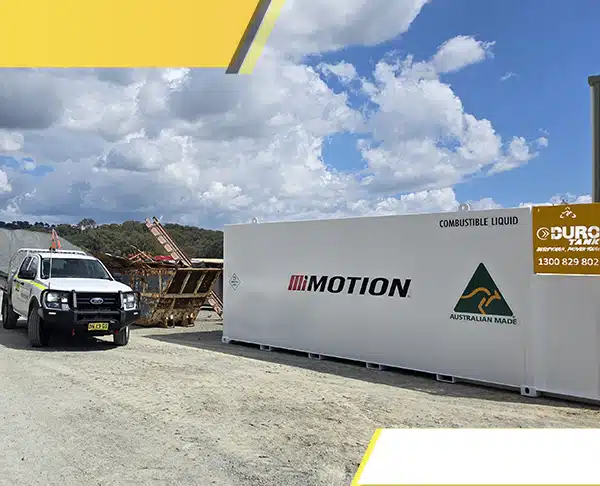
Furthermore, Durotank was highly accommodating when we requested custom signage. It turned out great and looked fantastic.
I highly recommend Durotank to any organisation seeking a seamless, efficient, and thoroughly professional supplier for diesel tank requirements.


Joe Valesini - AUS Inds Customer Relationship Manager Motion
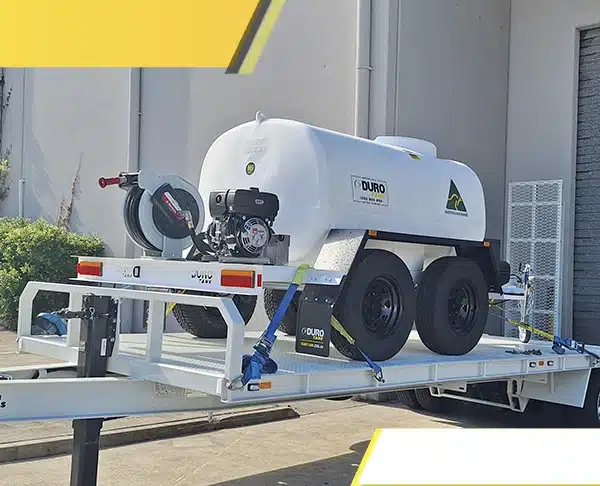
We had a great experience working with Durotank on our order for a 2,400L water cart trailer, set up for firefighting and tree watering. Their team was responsive throughout the process and delivered exactly what we needed on schedule, despite a very tight timeframe. The build quality is excellent - it’s clear a lot of care and expertise went into the manufacturing. We also value being able to support an Australian-made company and wouldn’t hesitate to recommend Durotank for both their product quality and service.
Joel Courtney – APMS Operations

We considered many other brands of diesel tank but quickly settled on Durotank - they ticked all the boxes. An Australian-made, self bunded quality tank with the ability to load and transport on-site whilst full is a winner.
The team communicated professionally with us regarding modifications and build timing. We will certainly use Durotank again and would confidently recommend them to others.
Andrew Reeves, Ethtec
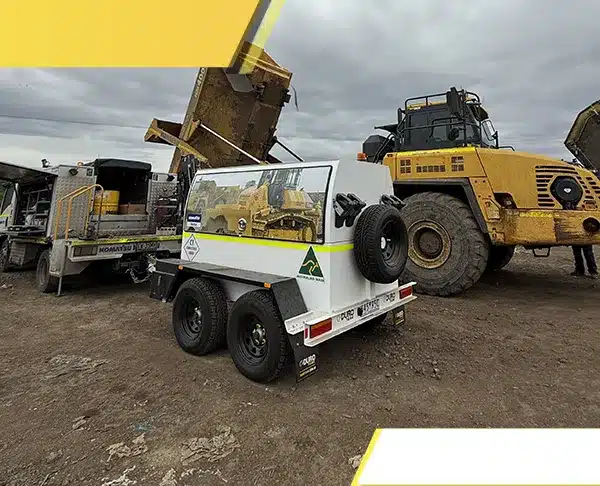
We had a great experience working with Durotank in purchasing our service trailer, from the enquiry stage to the delivery date the Durotank team were pleasant and very professional. Emily from the sales team answered any and all questions we had about specs and options, working with us to meet expectations and budget limitations. The production team kept us well informed of build schedule and approximate delivery dates. Overall we highly recommend the Durotank team if your looking for a service trailer, value for money is second to none and the quality is top notch.
Aaron Asquith - Leading Hand - Rental Komatsu Australia, Truganina Branch VIC
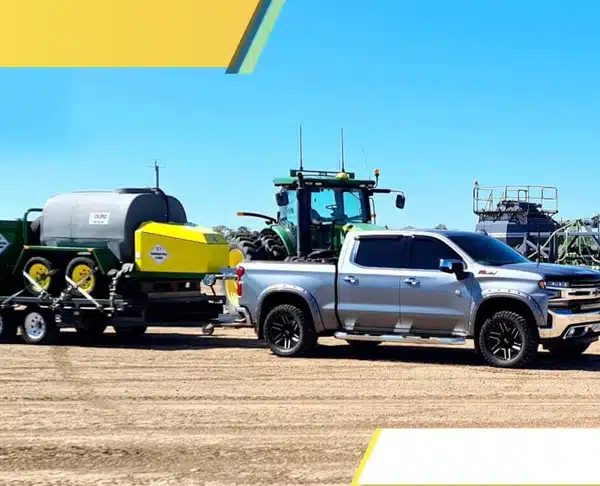
We purchased Durotank’s 2400 Litre poly water trailer with fire-fighter pump and hose reel, plus optional dribble bar and batter sprays attached.
Our property, Duxton Farm, borders the Kakadu National Park in the Northern Territory. Because of this, early season burning is extremely important to prevent uncontrollable bushfires later in the dry season. The trailer has been an invaluable asset to fire control – always full and ready to go when the call comes.
We’ve found it to be well balanced, empty or full, with the baffle ball system effectively controlling surge. We have had no issues with set-up, towing it with either a Landcruiser or Hilux.
Overall, we’re extremely happy with our purchase and the support from the Durotank team. We’ll be back.
Bruce Connolly, Northern Regional Manager, Duxton Farms

I purchased a Poly Tank Fuel Trailer from DUROTANK in April 2018. DUROTANK builds one of the best fuel trailers I have ever used. The build quality, engineering and attention to detail is unreal. The fuel trailer is rock solid, it tracks extremely well full of fuel at 100km/hr and its road worthy. All of the fittings are hoses are high quality hydraulic hose and crimped fittings so there are no leaks. The Durotank team is very easy to deal with and more than happy to help with any enquiries. The staff are friendly and it is a pleasure to do business with them. I’d buy another one in a heartbeat, that’s for sure
Ben Harris – AB Contract Farming
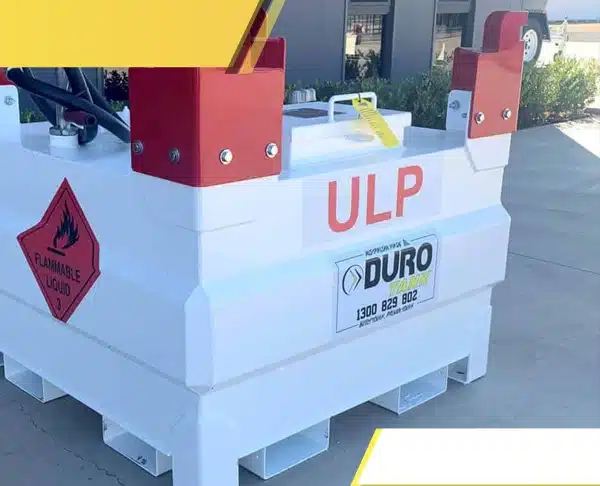
The Duro Cubes are going extremely well! My guys are very happy with them. Having them already saved us on oil transport on at least 2 occasions so far and has also allowed us to restructure our oil work days and use out of hours oil deliveries to make more efficient use of the time on site.
Field Supervisor, Electricity Distributor (AUSGRID)
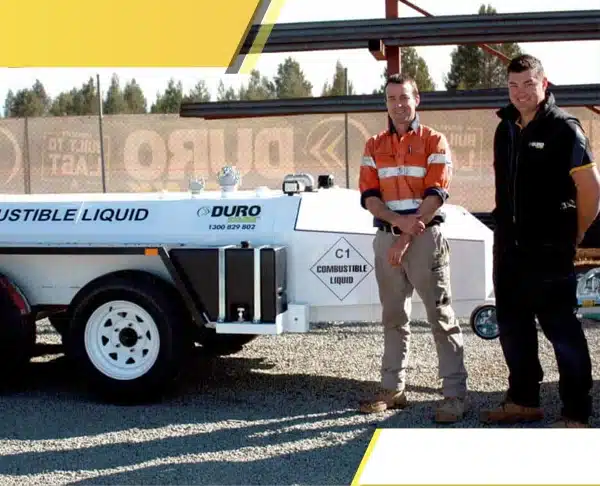
The fuel trailer I purchased from DUROTANK is well designed to withstand the harsh mining environment I work in, with no compromise to efficient and reliable fast fuel delivery
Brad Black – Hardrock Blasting Services
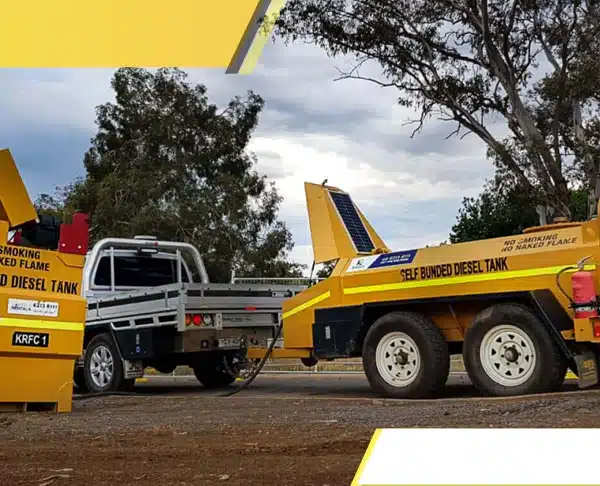
I would like to recommend Durotank to anyone that is considering their products. From first enquiry to after the product was delivered the customer experience was flawless.
Nick Dunlop – Kelton Rentals
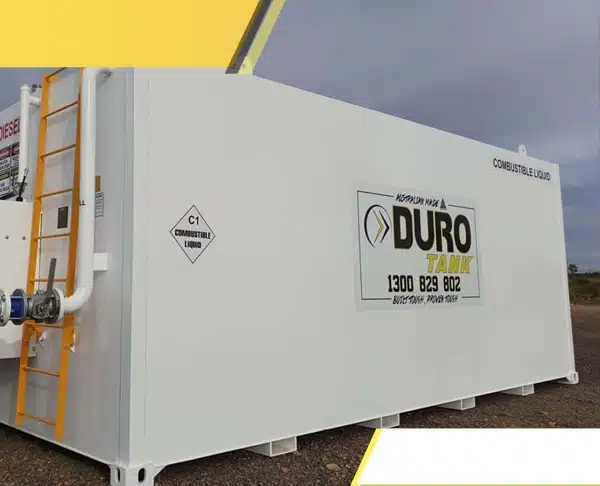
As a business owner I would highly recommend DUROTANK to any person who is serious about saving money, purchasing and storing their own fuel in bulk, particularly in today’s challenging economic times. DUROTANK supplied us an excellent quality Australian made fuel tank built to the specs that suited out business. Our staff love how easy it is to use and how much time it saves refuelling each week. We purchased the Smartfill System with it and its definitely a worthwhile investment both for use and fuel management. The aftersales service from DUROTANK has been outstanding.
Tony Grace – Lachlan Valley
The supply process from quotation to order placement, being kept informed of manufacturing process and delivery date and final delivery was seamless. I really appreciated the proactive approach to driving a positive Customer Experience. I couldn’t fault the product or service at all.
Peter – Meadows Family Restaurants
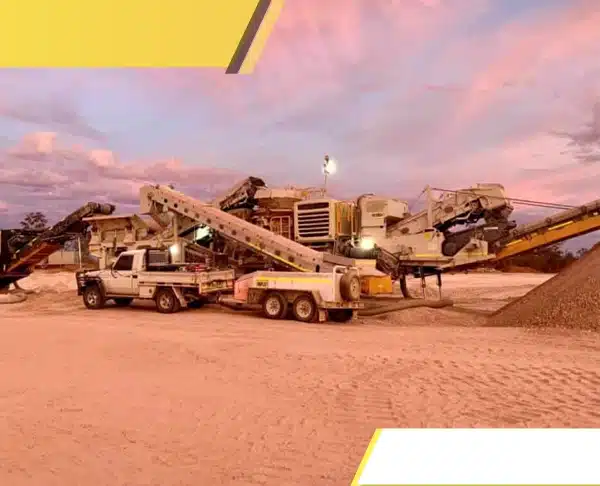
All our fuel trailers and on site tanks are supplied by Durotank which are built with strength and quality and always delivered on time, helpful and friendly staff, won’t get better.
